

Preliminary Findings on Opportunity Areas and Social Mobility
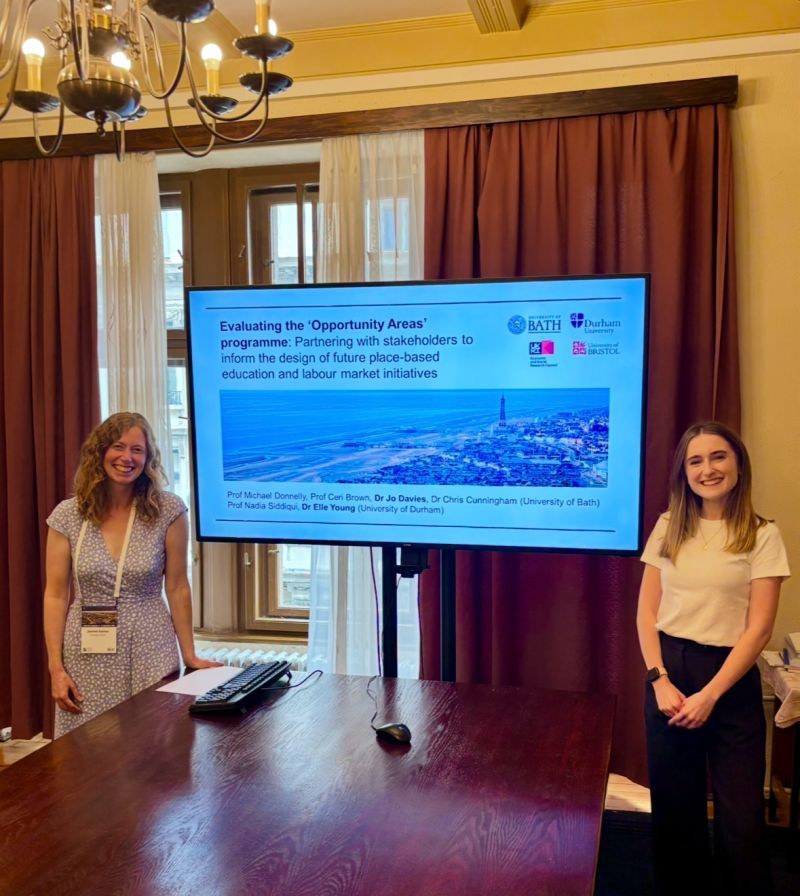
At the start of September, Dr Elle Young and Dr Jo Davies had the privilege of presenting our preliminary findings from the ‘From the Centre to the Periphery‘ project at the European Conference on Educational Research (ECER 2025) in Belgrade, Serbia. This was a valuable opportunity to share the early stages of our work evaluating the Department for Education’s Opportunity Areas programme (2017-2022), which aimed to improve life chances for young people in 12 social mobility ‘cold spots’ across England.
Although our evaluation is still in its infancy, several themes are already beginning to emerge. In particular, our work so far highlights the importance of:
- Local leadership and ownership matter – tailored, community-led solutions proved more effective than top-down approaches
- Partnerships and collaboration – between schools, local authorities, third sector organisations, and communities are crucial
- Sustained investment is crucial – short-term funding cycles undermine progress on deep-rooted inequalities
- Cross-sector engagement – bringing together education, skills, and wider community partners to improve social mobility
- Networks and legacies – many OAs left lasting collaborations, but sustaining momentum depends on local capacity and support
Building from our stakeholder engagement
A key part of our presentation was focussed on partnering with stakeholders. Since the project launched in 2024, we have:
- Held a project launch event in Derby: attended by over 40 stakeholders including DfE representatives, local authority leads, school leaders and young people
- Conducted 27 in-depth interviews: with OA chairs, boards members, and DfE officials across all 12 OAs, building on understanding of governance structures, local objectives, and the translation of national policy to local contexts
- Launched the ‘Periphery Speaks’ series: beginning in Bradford, where communities, charities, and schools came together to discuss social mobility challenges. The event showcased local voices and highlighted the power of networks in driving intergenerational change. Further regional events, including Ipswich Speaks, are planned
- Contributed to wider policy debates: including a panel event on the Future of Collaborative Outreach, organised by a nationwide education charity
Why this matters
The UK faces stark geographic inequalities in education and opportunity. For example, nearly 60% of workers and job seekers in London hold degree-level qualifications (in several boroughs the figure is over 70%), compared to less than 30% of people in coastal towns like Blackpool, post-industrial places such as Doncaster, and rural localities like North East Lincolnshire.
Our three-year evaluation is designed to not only assess the impact of the OA programme, but also to generate insights to help shape ongoing programmes, such as the government’s Priority Education Investment Areas (PEIA), and to inform the design of future policies in the UK and beyond.
Looking ahead
Our next steps include:
- Continue quantitative assessment using administrative and household panel data to explore the programme’s impact on young people’s education outcomes and expectations
- Deepen qualitative exploration through interviews and participatory activities with young people in selected sites
- Expand our ‘Periphery Speaks’ series with further community engagement events
- Share findings widely through dissemination events, evidence briefs and policy roundtables
We were delighted to exchange ideas with colleagues presenting on school-museum collaboration in Norway and university-community partnerships in Chile.
We look forward to returning to ECER in the future to present more advanced findings. For now, Belgrade offered a vital opportunity to exchange ideas, gather feedback, and strengthen the collaborative networks that underpin our work.